
History suggested that Justin Simmons wasn’t getting a long-term contract
In the past, John Elway had always inked franchise-tag players to long-term contracts, but a lack of returns might've changed his thinking this time

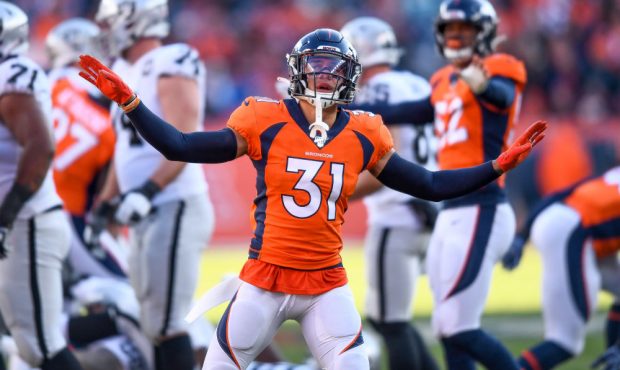
(Photo by Dustin Bradford/Getty Images)
(Photo by Dustin Bradford/Getty Images)
Last Wednesday, the deadline came and went for the Broncos to reach a long-term agreement with Justin Simmons. As a result, the safety will play the 2020 season under the franchise tag, earning $11.44 million on the one-year deal.
This came as a bit of a surprise to most, mainly because it broke from the pattern. Prior to Simmons, John Elway had exercised the franchise tag four other times during his tenure as the Broncos president of football operations. And all four times, he’d reached a long-term deal with the player prior to the deadline.
This time around, however, Elway broke the streak. In 2020, No. 7 chose a different tactic.
That left many people scratching their heads, wondering why the change of heart. Most guesses blamed the current situation in our country.
The uncertainty surrounding COVID-19 is definitely a logical reason. NFL teams don’t know how the pandemic will impact revenues this season, nor are they sure how it will impact the salary cap in 2021 and beyond. So committing big money to a player, as well as writing a hefty signing bonus check when refunds to season ticket holders are looming, is tricky right now.
Even in a normal year, however, there’s no guarantee that Elway would’ve signed Simmons to a long-term deal. His previous experiences handing out big contracts might’ve soured him on the whole idea.
Heading into the 2012 offseason, the Broncos placed the franchise tag on Matt Prater. In early July, they signed the kicker to a four-year, $13 million contract, with $3 million guaranteed.
The kicker had a so-so season during the first year of his new deal, but had a breakout campaign in 2013. During the Broncos record-breaking year, Prater earned a Pro Bowl invite by making 25 of 26 field goals, one of which was from an NFL-record 64 yards out, and 75 of 75 extra points.
Prior to the 2014 campaign, however, the kicker was suspended four games for violating the league’s substance abuse policy. He never played another game in Denver, landing in Detroit after the Broncos moved on to Brandon McManus.
The next year, Elway used the franchise tag on Ryan Clady. By mid-July, the Broncos had inked the left tackle to a five-year, $57.5 million deal, with $33 million guaranteed.
Two games into the first season of the new contract, Clady injured his foot and was lost for the season. He’d play the entire 2014 campaign, earning another Pro Bowl invite, but would miss another Super Bowl run in ’15 when he suffered a season-ending knee injury during training camp.
Clady was traded to the Jets after Super Bowl 50. All told, he played just 18 out of 48 regular-season and zero out of seven playoff games after signing the deal.
Heading into 2015, the Broncos used the franchise tag on Demaryius Thomas. On the eve of training camp, the team signed the wide receiver to a five-year, $70 million contract, with $43.5 million guaranteed.
Thomas had 105 catches for 1,304 yards during Denver’s Super Bowl season. He followed that up with a 90-catch, 1,083-yard campaign with Trevor Siemian and Paxton Lynch at quarterback, earning a Pro Bowl nod.
In 2017, the wideout’s numbers dipped a bit. And midway through the ’18 campaign, the Broncos traded Thomas to the Texans.
And finally, Elway used the franchise tag on Von Miller in 2016. At the 11th hour, Denver reached a six-year, $114.5 million agreement with the linebacker, with nearly $70 million guaranteed.
In the four seasons since, Miller has recorded 46 sacks, earned four Pro Bowl invites and been named All-Pro once. But his best season was in 2016, as the former Super Bowl MVP has seen his production tail off, including just 8.0 sacks in 15 games last season.
Across these four players, Elway shelled out a contracts that combined to be 20 years for $259 million, with $149.5 million in guarantees. He got 8.5 years of play and eight Pro Bowls in return.
While not terrible, that’s certainly not a great return on investment. In essence, the Broncos spent roughly $19 million per Pro Bowl season from the quartet of franchise-tagged players.
Given that meager ROI, it’s not surprising that Elway wasn’t eager to go down the same path a fifth time. And this time around, it wasn’t as much of a pressing need.
In 2012, Prater was coming off of a season in which he literally saved the Broncos from sure defeat with big kicks. He was drilling 50-plus yarders to win games during the storybook Tim Tebow run of success. Elway had to bring him back.
Clady played a premium position. As Denver has seen in the years since he left, finding a left tackle isn’t easy. Thus, the Broncos had to ink the future Ring of Fame inductee.
DT was the team’s best offensive weapon at the time of his deal. With Peyton Manning retiring, Elway couldn’t afford to deprive Denver’s new quarterback – whoever it turned out to be – of a marquee playmaker.
And Miller was coming off of winning MVP honors in Super Bowl 50. It would’ve been a PR nightmare to not back up the Brinks truck and give the linebacker whatever he wanted.
Simmons doesn’t have the same leverage. Yes, he’s coming off of a very good year, having earned second-team All-Pro accolades in 2019. But a case can be made that he’s not even the best safety on the roster.
Last season, Kareem Jackson was the best player on the field in two games. His return to action in Week 5 helped Denver secure their first win of the season, as he made big plays to help upset the Chargers. And in Week 14, he was all over the field against his former teammates, earning Defensive Player of the Week honors for his efforts against the Texans.
Simmons didn’t have any of those shining moment. He played every snap of every game, and was steady in the process, but he didn’t have game-changing highlights.
As a result, the safety isn’t in a position where the Broncos find him irreplaceable. In the past, Elway had no choice but to sign franchise-tag players to long-term deals. This time around, moving on doesn’t seem so unbearable.
In hindsight, no one should’ve been surprised by the fact that Justin Simmons didn’t get a long-term deal done in Denver. History, when looked at through the right lens, almost made that a foregone conclusion.
Related
 Davis Webb thinks Bo Nix is ready to go on a little run
 Broncos have Surtain, Coleman at practice for second-straight day
 Aaron Gordon could be the deciding factor of the Nuggets season
 2026 Broncos averaging fewest yards per play in franchise history… for now
 Courtland Sutton says ‘tide is going to turn’ and people will call Bo Nix ‘the best’
 Cooper returns to Broncos practice, speaks publicly for first time since arrests

Comments
0 Comments