
Nuggets cheap out, ship Peyton Watson to Cleveland
Peyton Watson will sign a four-year, $88 million deal with Cleveland that includes a player option and a trade kicker — the Nuggets get back picks

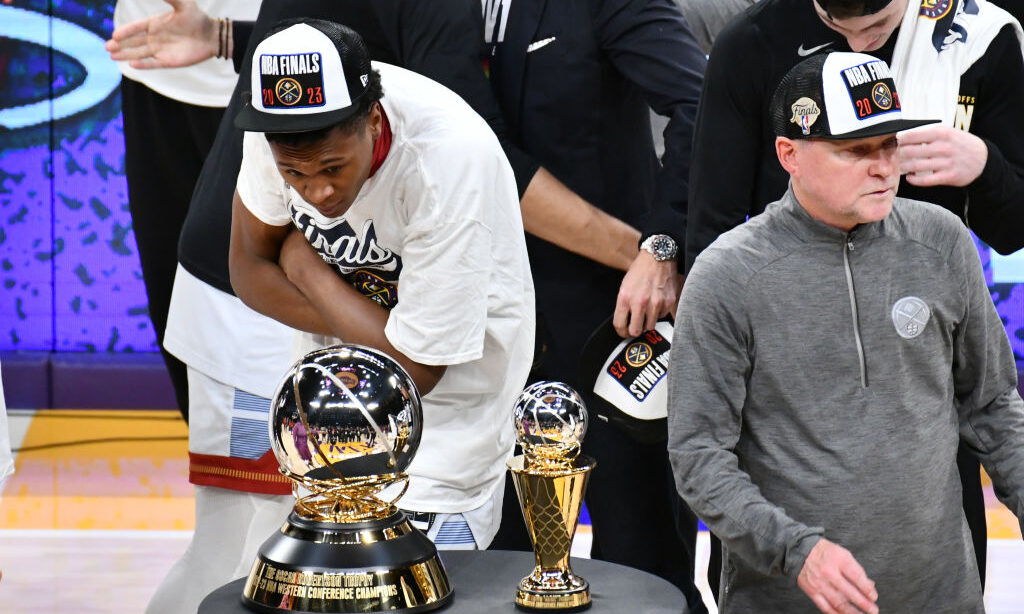
Photo by Allen Berezovsky/Getty Images
Peyton Watson’s time in the Mile High City is done.
The Denver Nuggets have agreed to a sign-and-trade sending Peyton Watson to the Cleveland Cavaliers, ESPN’s Shams Charania reported. Max Strus is headed to the Los Angeles Clippers, while the Nuggets receive an unprotected 2031 Cavaliers first-round pick, a 2032 Kings second-rounder and Washington’s Julian Reese, whom ESPN says the team will waive off his two-way deal. As part of the deal, the Cavaliers are sending Tre Mann, a 2027 Clippers second-round pick and cash to the Wizards for Cam Whitmore.
Watson will sign a four-year, $88 million deal with Cleveland that includes a player option and a trade kicker, per Charania.
After nearly three months of posturing, leaked offers, qualifying offer threats, four public suitors and a game of telephone over contract numbers that ranged from $70 million to $112 million, the Watson saga ends with Denver trading away the player many called its top offseason priority in May — and quite possibly its last realistic shot at developing a homegrown star alongside Nikola Jokic.
The return: a single unprotected first and a second-rounder.
That’s a far cry from the Walker Kessler-level haul — two unprotected firsts and two first-round swaps — that the Nuggets were reportedly demanding when sign-and-trade talks leaked earlier this summer. It’s a far cry from the “really good high-level player as well as a first-round pick” that Charania himself reported Denver’s price had evolved to just weeks ago.
The Nuggets blinked. And did so with two better players still left in restricted free agency (Jalen Duren and Bennedict Mathurin) and with an unclear motive of why in this moment. Though that could be revealed soon, with the team targeting DeMar DeRozan heavily, per Chris Haynes — a veteran scorer they likely could have signed without trading Watson. But the underlying motive is obvious: it’s all about money.
The $88 million figure lands almost exactly where the contract projections said it would. ESPN’s Bobby Marks projected four years and $90 million before free agency opened. Matt Moore of The Denver Dig landed at $21.5 million in average annual value. A source told me more than a year ago that former general manager Calvin Booth was prepared to offer Watson upward of $80 million, had he not been fired. The Nuggets’ own internal valuation, per The Consensus NBA, was reportedly around four years and slightly more than $80 million. Watson’s camp wanted north of $25 million per year — closer to Christian Braun’s five-year, $125 million extension. Cleveland didn’t even get there, and Denver let him go.
Strus heading to the Clippers as the third team in the deal solves the salary-matching puzzle that made every Watson sign-and-trade scenario so complicated. The Cavaliers had been trying to move Strus for weeks to create flexibility, first trading Dennis Schroder to Charlotte earlier this month. Routing Strus to LA instead of Denver means the Nuggets avoid taking back a player on an expiring contract they didn’t need — sidestepping the hard-cap trigger that would have locked them at the second apron.
For Denver, this is a money dump dressed up as a trade. The Nuggets shed Watson’s incoming $22 million annual salary and avoid a projected tax bill that Bobby Marks estimated could have reached $238 million in penalties alone had they kept Watson after matching the Spencer Jones offer sheet. That’s in addition to roughly $220 million in payroll. The combined figure — approaching $450 million — was never realistic for Kroenke Sports and Entertainment, who has proven time and again to watch their wallet ahead of the play on the floor – no matter what Josh Kroenke said at the podium in May about running it back.
An anonymous Western Conference scout told ESPN earlier this summer what ultimately proved prophetic: “They could easily just pay him and pay the tax, but we know how the Kroenkes operate.”
They operated exactly as advertised.
Watson averaged 14.6 points, 4.9 rebounds and 2.1 assists in 54 games last season, shooting 49.1% from the field and 41.1% from 3-point range. Through 15 games in January — with Jokic sidelined — he averaged 21.9 points and shot 46.2% from 3. His 53% on corner triples ranked sixth in the NBA among players with at least 1,000 minutes. He was 23, fit the most coveted archetype in the modern NBA as a 6-foot-8 two-way wing, and had a champion’s ring from Denver’s 2023 title run (though he barely played on that team).
Now he’ll be catching lobs from Donovan Mitchell and likely James Harden instead of Jokic and Jamal Murray.
Watson joins a Cleveland roster that made the Eastern Conference finals last season and desperately needed wing help — the same hole the Cavaliers tried to fill by pursuing LeBron James, then Jonathan Kuminga, before landing on the Nuggets’ restricted free agent. He slots in alongside Mitchell, Harden, Jarrett Allen and Evan Mobley as one of the most intriguing starting fives in the sport.
Denver now enters the season having traded Watson and Michael Porter Jr. in consecutive summers — the two most exciting wings developed during the Jokic era. The Nuggets sent out an unprotected first with Porter for Cameron Johnson and now get an unprotected first back for Watson. Johnson is on an expiring deal. The first-round pick could be somebody born in 2014 — the year Jokic was drafted.
The Nuggets’ roster now leans somehow even harder on Jokic, Murray, Aaron Gordon, Braun, Johnson and the hope that the tax savings translate into something more than an accounting victory. They still haven’t addressed their ballhandling depth. They’ve now seen their very bad defense get even worse. And they lost significant shooting. Meanwhile, the player who already provided two of those things — shooting and defense — and could have developed the third now plays in Cleveland.
Watson’s representation — Rich Paul and Klutch Sports — played the restricted free agency game as long as they could. Four suitors surfaced: the Clippers, Hawks, Bucks and Cavaliers. None could offer Watson a deal outright because every cap-space team had already spent its money. The sign-and-trade was always the only path, and Denver held the keys. In the end, the Nuggets used those keys to open the door and let Watson walk through it for a single first-round pick.
The picks can help the Nuggets orchestrate a deal before they’re ever selected. Reese, who was solid in a dozen games for the Wizards last year, would be slightly interesting coming to Denver if the Nuggets weren’t waiving him — even though they have two open two-way slots right now
This was always about money. Not Watson’s money — he got paid. The Kroenkes’ money. And in that math, an unprotected first-round pick in 2031 was worth more to the ownership group than a $238 million tax bill today. In itself, that’s strange.
The longest-running story of the NBA offseason is finally over. The Nuggets are lighter, thinner and most importantly cheaper.
Related
 Nuggets make contract decision on young shooter
 Nuggets’ Julian Strawther out at least six weeks
 Julian Strawther leaves preseason game with knee injury
 Nikola Jokic does hilarious stand-up bit in new Sprite ad
 Nuggets drop classic jersey to celebrate 60 years and ABA history
 NBA legend praises viral Nikola Jokic highlight assist

Comments
3 Comments
This has been the worst off season I can remember from the Nuggets. Hard to get excited for the upcoming season.
This is sad, a team that has one of the best players in the NBA won't support him. This "new" team will most likely not make the playoffs this year. And, if I'm Jokic, I would be looking for another team next summer, I wouldn't blame him. The Nuggets will ride him into the ground and break his health.
You're 100% correct... follow the money (before you time). From rough calculations: the 2nd apron tax would have represented 0.0003% of Josh's net worth. To make that more understandable for someone making $ 100K, that same tax % would equal.... $ 22. They should be spending like the LA Dodgers, instead Denver got the Milwaukee Brewers... so sad!