
Sean Payton’s analytics philosophy explained: trust the data — but trust your gut more
Sean Payton shares that he's not anti-analytics, but he won't exactly be carrying the flag for the fourth-down revolution either


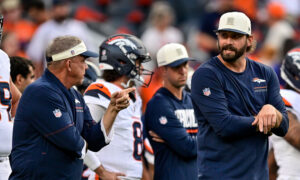
(Photo by Greg Fiume/Getty Images)
(Photo by Greg Fiume/Getty Images)
Sean Payton shares that he’s not anti-analytics, but he won’t exactly be carrying the flag for the fourth-down revolution either.
“I think let’s talk about a few things,” Payton began, unprompted, as only the third-year head coach of the Denver Broncos broke out a history lesson. “It’s not new at all.”
Analytics, in Payton’s world, aren’t buzzwords by broadcasters. They’re deeply embedded in the front office, particularly when it comes to building a roster. Think less “go-for-it” on fourth and more “is this receiver too skinny to make it in the league?”
Take rookie quarterback Bo Nix — Denver’s quarterback of the present and future. The Broncos liked that he had one “negative” play — a sack, interception or fumble — for every 82 snaps in college. That data point, Payton said, holds up over 30 years of quarterback study.
“That stands out,” Payton said Friday. “It’s valuable. It’s extremely valuable.”
Payton says the Broncos prototype every position, in the same way rival Raiders legend Al Davis once did. There’s an ideal frame and skillset for a cornerback, left tackle, even for a running back, where the requirement isn’t height but size. “Short, not small,” Payton explained, referencing RJ Harvey. “You wouldn’t say small. You’d say short.”
Still, Payton’s not handing over the playsheet to a spreadsheet.
“Yeah, 2025 — it’s different in-game,” he admitted. “And yet, you can’t lose track of what’s going on.”
He brought up a moment from his days in New Orleans. It was a game in St. Louis, and an eager young exec once questioned why Payton kicked a field goal instead of going for it.
“I said, were you paying attention?” Payton asked. “We had a young left tackle, and Robert Quinn had just sacked Drew Brees three times.”
Payton basically explained that there are many more things going into decisions than just the binary of going for it or not.
Payton also referenced the 2024 NFC title game, where Detroit’s Dan Campbell — someone Payton knows well — decided to go for it on fourth down rather than take a field goal with a 17-point lead. They didn’t get it. San Francisco came back and won.
“You can’t let analytics trump instincts,” Payton said.
That especially applies when it comes to two-point conversions, where Payton admits he’s got a chart, but only pulls it out situationally.
“If it’s a low-scoring game, I might apply that chart a little earlier. If it’s a high-scoring game, I won’t even look at it until the fourth quarter,” he said.
But Payton flipped the thought process on two-point plays with something he’s shared in the past. Sometimes the coach will use his best two-point play before even getting into that situation.
“If I love a two-point play, and I’m first-and-goal from the three, I’m calling that play. I’m not saving a great two-point play when I can score six with it,” Payton explained. “And then, as soon as the play’s run, you’re checking it off. You’re like, ‘Alright, what’s our next go-to?’”
All of this, Payton insists, is part of the weekly evolution — the Monday morning meeting that starts with a simple question: “What would we have done differently if we played that team again this weekend?”
For all the data, all the decades of research, all the prototype spreadsheets in the front office — Payton still relies on something old-school.
“I’ve been blessed with good instincts,” he said. “You’re not always right.”
So yes, analytics matter, and it’s one of the reasons the Broncos have their quarterback, but Payton still trusts his gut.
The Broncos are trusting both analytics and Payton’s guts to take another step in 2025.
Related
 Report: Webb changed some Broncos offensive terminology; Payton changing it back
 Broncos’ Elliss seen with crutches, boot at CU game
 Ex-Broncos GM John Beake, who helped team win two Super Bowls, dies at 87
 Broncos’ Dobbins vows to recapture old form: ‘I’m gonna fix it’
 Jonathon Cooper removed from commissioner exempt list
 Sean Payton will either fix Bo Nix or ruin him

Comments
0 Comments