
Broncos defense must improve at its core if it’s to live up to potential
The Broncos are getting some stellar individual performances on defense, but with Pat Surtain not at his DPOY form and the inside linebackers struggling, the unit is bogged down.

Watch: Bo Nix Under Pressure: How Can The Broncos Fix Their QB Problem? Orange & Blue Today | 21 mins
On the Broncos defense, you don’t have to look far to find superlative individual performances so far this season.
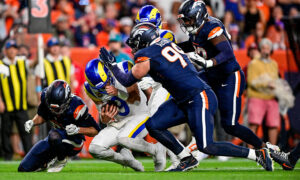
Edge rusher Nik Bonitto:
• No. 1 among all players with at least 25 pass-rush snaps in pressure rate, per Next Gen Stats (31.3 percent)
• No. 1 in quick pressures (under 3 seconds) with 11, per Next Gen Stats
• No. 1 among edge rushers in quarterback-hit rate (minimum 25 pass-rush snaps) per Pro Football Focus (1 every 6.4 pass-rush opportunities)
• No. 4 in pass-rush win rate, per ESPN Analytics
Edge rusher Jonathon Cooper:
• No. 5 among 112 eligible edge rushers (minimum 25 pass-rush snaps) in pass-rush win rate, per PFF (26.4 percent)
Edge rusher Dondrea Tillman:
• No. 1 among 85 eligible edge rushers (minimum 25 run-stop opportunities) in run-stop percentage, per PFF (14.8 percent)
All four active edge rushers — Bonitto, Cooper, Tillman and Jonah Elliss:
• Rank in the top 30 among 112 edge rushers with at least 25 pass-rush snaps in pressure rate, with Bonitto, Cooper and Elliss all in the top 10 at Nos. 2, 7 and 10, respectively
Defensive lineman Zach Allen:
• No. 1 among all interior defensive linemen in quarterback-hit rate (minimum 25 pass-rush snaps) per PFF(1 every 10 pass-rush opportunities)
• Allen and D.J. Jones are both in the top 20 of 112 interior defensive linemen in pressure rate (minimum 25 pass-rush snaps), per PFF data
Defensive lineman Enyi Uwazurike:
• No. 6 among 103 interior defensive linemen (minimum 25 run-stop snaps) in run-stop percentage, per PFF
And the Broncos as a whole are No. 5 in pass-rush win rate, per ESPN Analytics.
SO, WHAT’S WRONG?
Well, they’re No. 17 in run-stop win rate.
And while Pat Surtain II remains among the very best in allowing minimal target separation — just 1.3 yards, per Next Gen Stats, which places him among the top five defensive backs in football, opponents are catching 66.7 percent of passes thrown his way.
His coverage EPA — expected points added — is plus-6.7; it was minus-24.0 last year; for defenders, it’s like golf; minus is good.
But fellow cornerback Riley Moss also ranks high in allowing minimal separation; he’s tied for eighth at 1.6 yards; his coverage EPA remains in the red, at minus-0.5. While he’s been the target of fan vitriol, he shouldn’t be, and on the game-tying touchdown last Sunday, his coverage was tight.
What has changed in the last two weeks is the frequency of targets in Surtain’s direction. Daniel Jones and Justin Herbert threw in his direction 14 times in the last two games; that matches the total number of times opposing quarterbacks targeted him in the final five games — including postseason — of last season.
Surtain was targeted 52 times in 16 games last year; he’s on pace to be targeted 85 times this season. He allowed 116 yards in the first eight weeks last year; he’s at 114 through three games this year (per PFF data). And this changes the calculus for the entire Broncos defense.
AT THE CORE, THE PROBLEMS PERSIST
“Things fall apart; the centre cannot hold.” — William Butler Yeats
Much of the hope for improvement for Denver’s defense after its fading form down the stretch last season resided in the return of Alex Singleton from a torn anterior cruciate ligament and the addition of Dre Greenlaw via free agency.
But Greenlaw won’t make his regular-season debut until at least Week 7 after landing on injured reserve last Saturday, and the numbers aren’t kind to Singleton and Justin Strnad as a duo.
Consider this: The Broncos are one of just two teams with a pair of linebackers who are each allowing passer ratings of over 110.0 when targeted (with a minimum of 20 coverage snaps), per Next Gen Stats.
Opposing quarterbacks have a 111.5 rating at Strnad’s expense and a 118.3 rating when throwing in Singleton’s area. The Miami Dolphins are the only other team with a pair of linebackers — Tyrel Dodson and Jordyn Brooks — each allowing ratings north of 110.0 when targeted.
Per PFF data, both Singleton and Strnad have allowed at least 10 yards every time they’ve been targeted, placing them among the bottom 17 of 78 inside linebackers with at least 20 coverage snaps so far this season. And with Strnad allowing an average of 16.8 yards when targeted, he ranks 78th of those 78; Singleton is tied for 63rd.
It’s not much better against the run. Among 77 inside linebackers with at least 77 run-stop opportunities per Pro Football Focus, neither Strnad nor Singleton rank in the top half in run-stop percentage. Strnad is tied for 44th (6.2 percent) and Singleton sits 61st at 3.9 percent.
Their results must improve.
BRONCOS DEFENSE FACES LARGER TRENDS
But beyond the inside linebackers, there is a worrisome pattern: In most of the Broncos’ last nine games, there is some ghastly number — or numbers — that reveal a significant breach in the Broncos defense:
Dec. 2, 2024 vs. Cleveland: Broncos allow 552 yards, the second-highest tally against the Broncos since the 1988 season; ex-Denver receiver Jerry Jeudy breaks the record for most receiving yardage ever accumulated against the Broncos.
Dec. 15, 2024 vs. Indianapolis: Colts rush for 149 yards, the most allowed by the Broncos in 16 games. (Buffalo would exceed this tally four weeks later; the Colts surpassed this by 18 yards at Indianapolis in Week 2 of this season.)
Dec. 19, 2024 at Los Angeles Chargers: After averaging 241.5 yards in their previous four games — and just 66.3 on the ground — the Bolts explode for 380 yards, including 117 of the rushing variety, as they pull away in the second half, scoring 21-consecutive points to overturn a two-score deficit.
Dec. 28, 2024 at Cincinnati: The Broncos fail to force a single punt in regulation for just the fourth time in club history. Only a pair of fourth-down stops and Pat Surtain II’s forced fumble on Tee Higgins save the defense as the Bengals ransack the Broncos for 499 yards, with Joe Burrow torching Denver for 412 yards on 39-of-49 passing, becoming the second 400-yard passer against Denver in the month.
Jan. 12, 2025 at Buffalo: Denver forces just one punt — after an 11-play drive — and the the Bills hold onto the football for 41 minutes and 43 seconds, dealing the Broncos their worst time-of-possession disadvantage since Dec. 18, 1983.
Sept. 14, 2025 at Indianapolis: For just the fifth time in club history (including playoffs) — and the second time in a five-game span — the Broncos fail to force an opponent to punt in regulation. Since the 29-28 loss at Lucas Oil Stadium doesn’t go to overtime, it goes into the books as one of five games in Broncos annals in which they failed to force a punt. It’s also the fourth game in this current nine-game span in which the Broncos have allowed at least 450 yards of total offense; they had two such games in their previous 63 contests.
Sept. 21, 2025 at Los Angeles Chargers: Broncos allow 29 first downs, more than all but 10 games in club history; Denver’s minus-20 first-down deficit — 29-9 — is the franchise’s worst for a single game in 59 years.
Every week but two, it’s something. And in those two weeks where the defense flourished, one was against the Chiefs’ backups and another was against a team featuring a rookie No. 1 overall pick at quarterback starting on the road — a scenario that has never worked out well in Week 1 in the common-draft era.
This week — against a Bengals team without Burrow that appears to be foundering — Denver’s defense has a chance to get better.
The last time Vance Joseph’s defense had a spot of bother like this, it was early in the 2023 season. Beginning with a Week 6 trip to Kansas City that year, it rebounded and became one of the league’s best units for a 24-game stretch that spanned two seasons.
A similar return to form is exactly what the Broncos need to help get them on track to their bold and stated ambitions.
Related
 Broncos rule out Dondrea Tillman for Week 4
 Sean Payton preps for one of the hottest Broncos games ever
 Report: Sean Payton will be on ‘ManningCast’ for Saints, Falcons anniversary game
 Spelling out what Bo Nix has to fix in order to eliminate the slow starts
 Broncos pass rush prepares for QB who hasn’t been sacked this season
 Broncos edge rusher Tillman does not participate in practice for second-straight day

Comments
0 Comments