
What does “success” look like for Deion Sanders in year four?
The Buffs head into the 2026 season with lofty expectations on their head coach, but the midday show isn't sure the program is built to meet them

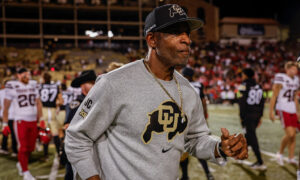
Photo by Alex Slitz/Getty Images
There is a strange tension surrounding the Colorado Buffaloes football program heading into year four of the Deion Sanders era. Three seasons in, the results have been wildly inconsistent. A 4-8 debut, followed by a 9-4 step forward, followed by a 3-9 slide. That kind of zigzag pattern doesn’t lend itself to confident projections. And yet, the noise around the program remains as loud as ever, even when the production hasn’t matched the volume.
On a Monday edition of the midday show on 104.3 The Fan, hosts Josh Dover and Jake Shapiro tried to set realistic expectations for what the 2026 Buffs might actually look like. And the conversation quickly drifted toward a more uncomfortable question: What does success even mean for this program at this point?
Dover laid out his projection without much enthusiasm.
“I don’t see like seven or eight wins on this schedule. I think if things go very good, you could get to seven, maybe eight. That’s kinda mediocre right?” he said.
Emphasis on the word “mediocre.” Because for a program drawing the kind of national attention Colorado attracts, and paying its head coach the kind of salary it pays, finishing in the middle of the pack feels less like progress and more like treading water.
Dover took the critique a step further.
“Are we all gonna praise Deion, making $10 million a year, to be bowl eligible and go to another Alamo Bowl?” he asked.
Fair question. Bowl eligibility is the floor at most major programs, not the ceiling. And the expectations attached to Sanders’ arrival, the recruiting splash, the media saturation, the cultural transformation, were never going to be satisfied by occasional appearances in mid-tier bowl games.
Shapiro pressed Dover to clarify his floor.
“So your initial projection, looking at their schedule, was they are going to go bowling?” Shapiro asked.
“Yeah like just in. Like at six wins,” Dover responded.
Shapiro wasn’t sure if even that was reasonable.
“Okay, I think that’s hopeful,” he said.
Then, Shapiro explained why his skepticism runs deeper than the schedule itself.
“You have to keep in mind that over the offseason, the Buffs lost their best defensive player, their second best defensive player, their best offensive weapon and their best overall offensive player in Jordan Seaton,” he said.
That is a roster-level reset, not a roster-level reload. Losing that much production in a single offseason puts the program in a position where simply matching last year’s win total would qualify as an accomplishment, and last year’s win total was three.
The energy in Boulder hasn’t changed. The recruiting headlines still come. But the on-field math is harder to ignore. Dover and Shapiro aren’t predicting disaster. They’re just being honest about the gap between the volume of the brand and the substance of the roster. And in college football, eventually, the substance is the only thing that matters.
Related
 Deion Sanders names Buffs starting QB, says: ‘Throw the ball to the guys on our team’
 Did a jersey swap just reveal Deion Sanders is changing Buffs QBs again?
 TV networks also down on Prime’s Buffs, next game will be very late
 Did Coach Prime’s Buffs playbook leak at team hotel? Internet sleuths have evidence pointing to yes.
 Deion Sanders visits the Nuggets in Boulder
 Prime won’t name Buffaloes QB1, report reveals change

Comments
0 Comments