
Watch: Folsom Field’s turf is in, highlighted by eye-catching end zones
For the first time since 1998, Folsom Field in Boulder is filled with turf instead of natural grass, a move that will allow the university to hold more events in the stadium

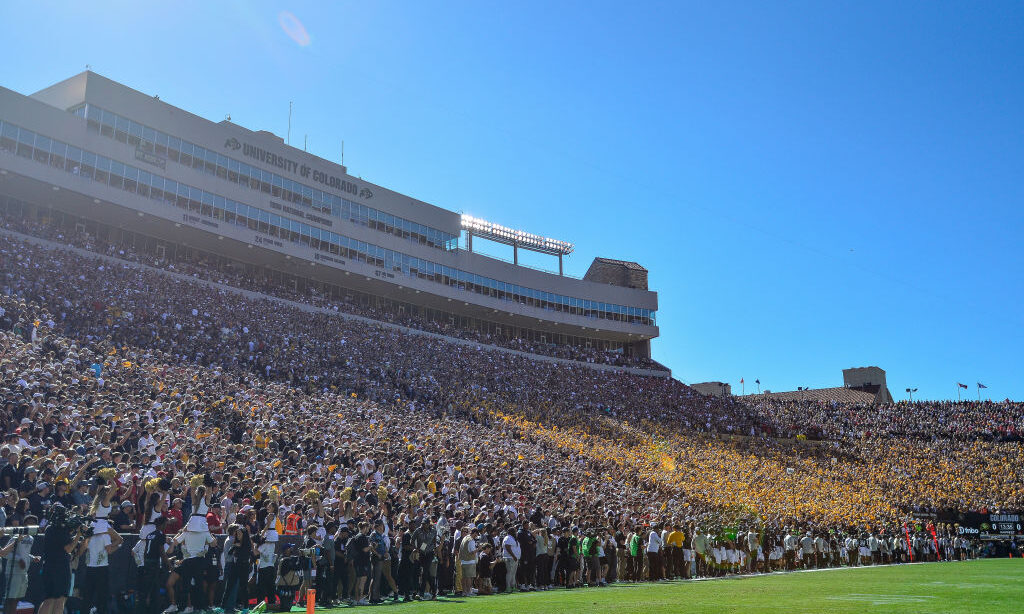
Photo by Dustin Bradford/Getty Images
The University of Colorado announced that Folsom Field would be moving from a natural grass playing surface to artificial turf for the 2025 season in a move that had a handful of reasons. The turf allows the university to hold other events such as concerts during the football season, it will look better later in the year if the Buffs were to ever host a College Football Playoff game, and there is no need to do regular upkeep on it like with the grass field.
The grass has been in place since 1999. Is the program hoping to recapture some of the magic of the 1990s by reverting to the artificial surface?
With the Bolder Boulder now in the rearview mirror, the last big event in the historic stadium for a while, CU executed the surface change, saying goodbye to the grass. The most notable difference from the grass to the turf is the color in the end zones, a black background behind the gold letters.
Progress over the past week at Folsom Field installing @AstroTurfUSA 3D3 with nylon rootzone. Getting prepared for infill sand and @TeamBrockUSA by the end of the week. #FindYourFooting #UTTBuilt 💪🏼 #YourFieldOurPassion pic.twitter.com/WFzgZWRpqU
— United Turf and Track (@UnitedTurfnTrak) June 12, 2025
Are y’all messin with the new Folsom Field artificial turf?👀🔥 pic.twitter.com/1Hh4hbGeZc
— GUCCE🦬🐦⬛ (@gucceCU) June 11, 2025
Something else to note is that the berm that read “COLORADO” behind the south end zone has been scraped and is just concrete for the time being, as the university plans to redo that as well. The repairs for the berm are long overdue, as that piece of the stadium looked to be crumbling more and more with each passing day.
There has been a debate going on in the football world — college and NFL — on which surface is safer to play on given the amount of non-contact injuries the sport has seen in the last decade.
The NFLPA has been strong on the increased injury risk that comes with playing on turf.
Based on NFL injury data collected from 2012 to 2018, the NFLPA says, “players have a 28% higher rate of non-contact lower extremity injuries when playing on artificial turf. Of those non-contact injuries, players have a 32% higher rate of non-contact knee injuries on turf and a staggering 69% higher rate of non-contact foot/ankle injuries on turf compared to grass.”
The NFLPA also shared that 92% of their players prefer natural grass and 6% of the players surveyed were indifferent.
However, money is king, and it is one of the driving forces behind CU football, and this is a move that will be able to slightly cut some costs while greatly increasing the university’s revenue.
There are a handful of concerts, starting with Phish on July 3, throughout the summer that will allow fans to possibly get their first look at the artificial surface, depending on how much of it is covered by the concert equipment. For football, the first look will be on August. 29 when the Georgia Tech Yellow Jackets come to Boulder to kick off the 2025 season.
Related
 ‘I really hope you don’t count me out’: Deion Sanders stays defiant as Colorado’s skid hits four
 Travis Hunter does something no NFL player had done in 24 years
 Deion Sanders breaks his own rule after Colorado’s near-upset of No. 11 Utah
 Deion Sanders names Buffs starting QB, says: ‘Throw the ball to the guys on our team’
 Did a jersey swap just reveal Deion Sanders is changing Buffs QBs again?
 TV networks also down on Prime’s Buffs, next game will be very late

Comments
0 Comments