
A Pete Carroll reflection on Russell Wilson illuminates why Sean Payton passed less often
Russell Wilson played for Pete Carroll for 10 seasons in Seattle, and Carroll now believes he should have run the ball more with Wilson at QB.

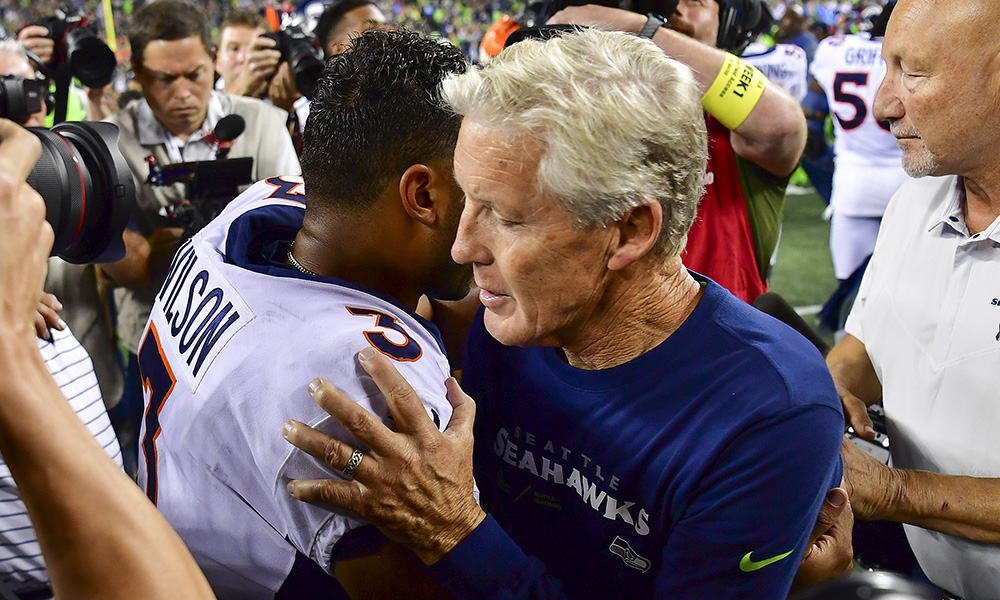
(Photo by Jane Gershovich/Getty Images)
(Photo by Jane Gershovich/Getty Images)
Pete Carroll was in a reflective mood this week. Which is quite understandable, given that his 14-year run as Seahawks coach ended.
Ten of those seasons came with Russell Wilson as the quarterback. And as Carroll looked back at the years with Wilson, he understands one thing: He should have de-emphasized the passing game in Seattle’s offense as time progressed.
Pete Carroll, on @SeattleSports, notes that as Seattle’s offense evolved during Russell Wilson’s time there to pass more often,“We did go too far … I think we were more difficult to deal with that way (emphasizing run/scramble) than trying to out-yard them in the passing game.” pic.twitter.com/b8rRD5oFvg
— Andrew Mason (@MaseDenver) January 12, 2024
“As we got coming out of that phase where we really could run it a lot, and there was an emphasis on the passing game, we did go too far,” Carroll told Seattle Sports this week. “I wish we would have kept the blend more in the mixture, because I think we were more difficult to deal with that way than trying to out-yard them in the passing game.”
And that illuminates what Sean Payton tried to do as the Broncos’ 2023 season progressed.
PETE CARROLL WAS MORE SUCCESSFUL WITH LESS OF WILSON AS A PASSER
The Seahawks’ peak years with Wilson came in his first four seasons as a quarterback. The presence of the “Legion of Boom,” an all-time secondary, had something to do with that, of course. So too did having running back Marshawn Lynch, one of the most tenacious running backs in modern NFL history.
In Russell Wilson’s first four seasons, the Seahawks had Wilson pass plays executed in no more than 52.5 percent of their snaps. Seattle advanced to the divisional round or later in each of those seasons.
In the following six seasons, the Seahawks passed more often than that five times — only falling below the 53-percent figure in 2018. Seattle missed the playoffs twice and lost in the wild-card round two other times.
In that time, Wilson became less of a runner. When removing kneeldowns from the equation, he ran on at least 7 percent of the Seahawks’ offensive snaps in five of his first six seasons. After that, he never ran on more than 6.6 percent of the offensive snaps in a given year.
“In the game, when your quarterback is a runner, and he’s mobile and he can escape, that’s a [factor] in the game that really neutralizes a lot of stuff,” Pete Carroll explained. “And when you have that, and you use it well — where it’s a threat, but also it’s a surprise — the threat is in the scheming of the running plays, and the surprise is when you scramble. That factor really is a big factor in the game, if you can control it.”
Of course, usually quarterbacks who run that often aren’t the type of timing-and-precision pocket passers that many teams prefer.
“Often, that type of player isn’t really the most proficient type of passer; he’s an athlete guy, moreso,” Carroll said. “And when you have that blend, which we had for a number of years — just look at Russ’ rushing numbers when he was around 500 yards a year.”
Wilson had at least 80 non-kneeldown carries in five of his first six seasons. He hasn’t reached that since. But his 67 runs in 2023 represented his highest total since 2018. And his rushing-success percentage of 55 percent is his best since 2015, his fourth NFL season.
“That complement to the rest of the running game, that’s what makes you on top of the charts. It’s that factor,” Carroll said. “And you can see it right now. Lamar’s probably at 700 or 800 yards rushing, something like that. And that factor neutralizes really good defense.”
HOW ALL THAT REFLECTS IN THE PLAY-CALLING OF PAYTON
During the Broncos’ first five games, the Broncos ran pass plays with Wilson on at least 61 percent of their snaps each time. They went 1-4.
Only twice after that did the Broncos reach the percentage — against Minnesota, when the Vikings stacked the box and forced the Broncos to pass, and against New England five weeks later, with the Patriots utilizing some similar tactics and fronts. In those games, the Broncos went 6-4 — including the 5-game winning streak.
In Weeks 1-5, the Broncos executed passing plays with Wilson on 62.9 percent of their non-kneeldown snaps … with him running on 6.0 percent of them.
Payton pivoted in Kansas City in Week 6. And the result was a closer-than-expected loss that, somehow, was a one-score game deep into the fourth quarter.
That was a leading indicator that the change worked; the Broncos kept leaning into it. In Wilson’s final 10 starts of the season, they had pass plays on 52.8 percent of their snaps — and Wilson runs on 8.4 percent of the snaps. Wilson’s 50 runs in those 10 games would have translated to 80 in a 16-game season — a total more typical of his first six years in the NFL.
In other words, Payton did what Carroll now believes he should have done.
Early in the season, the Broncos leaned into Wilson as a passer to an even greater degree than Seattle did in Wilson’s final years there. They did what Carroll came to regret.
And when the Broncos did what Carroll believed the Seahawks should have done … they got results.
If Carroll and Payton can both see this with Wilson, it speaks volumes about the outlook for the quarterback — whether he stays in Denver or heads elsewhere.
Related
 Cooper returns to Broncos practice, speaks publicly for first time since arrests
 Bo Nix says ‘I’m not scared’ but admits mental aspect coming back from ankle surgeries
 Sean Payton on his play-calling so far: ‘You’re never satisfied’
 Jonathon Cooper might be on a snap count if he plays in return from exempt list
 Broncos get Jonah Coleman, Pat Surtain II back on field
 Former Broncos DL John Franklin-Myers helps de-escalate scary situation with Titans

Comments
0 Comments