
Prime Time isn’t up: Colorado expected to keep Deion Sanders for a fifth season
Deion Sanders is expected to remain the Colorado Buffaloes' head coach for a fifth season

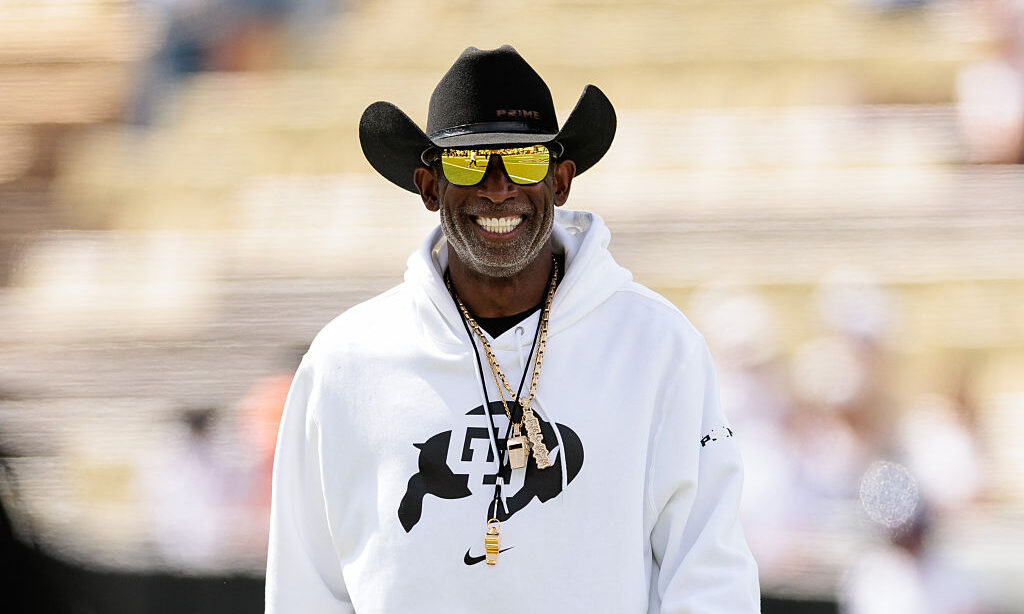
Photo by Andrew Wevers/Getty Images
Deion Sanders is expected to remain Colorado’s head coach, The Athletic’s Bruce Feldman reported Sunday. The news came a day after a 47-28 win over UCF at Folsom Field ended a 5-7 season.
“There was a lot of question leading into this weekend,” Feldman said on The Athletic’s “The Audible” podcast. “In the second half of the season, it seemed like when things kind of stabilized with the quarterback situation a little bit, things picked up, and now there feels like there’s a lot more optimism and enthusiasm around there.”
Athletic director Fernando Lovo met extensively with Sanders and his camp Friday, The Athletic’s Ralph Russo said on the same podcast. Russo said sources told him the two talked again after Saturday’s game to set up a longer conversation Sunday. Much of it, he said, centered on one question: “Will Deion make some changes here?”
Sanders made his position clear Saturday. Asked whether he hoped to return in 2027, he said, “Yes,” and added, “Boulder’s been so kind, so wonderful to me and my family, my friends, my loved ones, the staff.”
That’s a long way from where this looked headed a week ago, and a lot closer to where Lovo started. At his introductory press conference in January, he told Sanders, “Coach Prime, I’m coming out right behind you, baby. We’re going. OK?”
Sanders is 21-28 at Colorado. The Buffaloes finished 5-7 and 3-6 in the Big 12, their third losing season in four years. Since Shedeur Sanders and Travis Hunter left for the NFL, Colorado is 8-16.
Money was part of the decision. Sanders signed a five-year, $54 million extension in March 2025. Firing him before the end of the year would have cost about $25.5 million, or 75% of what’s left on the deal. The athletic department also projected a record $27 million deficit for the fiscal year that ended in June. Next year, the buyout drops to about $17.25 million, but only after CU pays another season of his roughly $10 million salary.
That price is why so many people here assumed Prime was safe, until things got out of whack this fall. A five-game losing streak, a loss at Cincinnati that ended Colorado’s bowl hopes and a growing list of embarrassments from Sanders’ mouth and his henchmen had plenty of people around here ready to see him go. One of them was a “losing games, but winning life” line that went viral for all the wrong reasons.
Then the Buffs closed strong. They beat No. 14 Houston 42-32 on Nov. 13, Colorado’s first win over an AP Top 15 team since 2007, and they ran for 306 yards against UCF. Russo pointed to something else, too: “This team kept playing hard for him.” The includes the hard-fought loss against Utah.
It’s hard to overstate what his first two years meant here. In 2023, Colorado went from a 1-11 afterthought to the center of college football. Every home game at Folsom sold out, celebrities lined the sideline and the national TV slots came back. In 2024, the Buffs went 9-4 and played in a bowl game. Hunter won the Heisman Trophy, and Shedeur Sanders rewrote the school’s passing records.
Then the two of them left, and the national spotlight left with them.
The 2025 season, the year Sanders was treated for bladder cancer, ended 3-9. This year, a 2-0 start gave way to penalties, turnovers and quarterback questions. Former five-star recruit Julian Lewis was benched at halftime against Baylor and never got the job back. Asked in October whether Lewis would get another chance, Sanders said, “That’s on him.” Sanders seemed to make it a battle between himself and Lewis rather than working with his young quarterback. Lewis was later hospitalized after a medical emergency at practice.
Discipline, special teams, an inconsistent run game and shaky quarterback play outside of his son were problems all four years. They lasted through four offensive play-callers and three defensive coordinators. Three of Sanders’ four teams ranked in the bottom 15 nationally in penalties, according to BuffsBlog.
That’s the list Lovo’s “changes” have to address.
Sanders has been good for CU in plenty of ways. Applications hit a record. Peggy Coleman, the program’s beloved superfan, became a national celebrity.
“He put us on every news report, every sports show, for two to three, four years,” former CU coach Gary Barnett said recently. “You can’t buy that publicity.”
But for about $10 million a year, the highest salary in the Big 12, Colorado has gotten roughly the same football it had in the dormant years. It just came with better facilities, a new conference, easier transfer and admissions rules, and a lot more money behind it.
Lovo had a view from the outside. At New Mexico, he hired Jason Eck, and the Lobos are 10-2 and headed to the Mountain West title game on a fraction of CU’s budget. Lovo also worked at Ohio State and Texas, so he knows what a program on the rise looks like. Sanders was never his hire. As of Sunday, he’s Lovo’s coach.
Rick George was desperate enough to hire Sanders four years ago, when CU had hit a new rock bottom at 1-11. Sanders was desperate enough to make Boulder his home so he could build his TV profile and get his sons into the NFL. Along the way, he seemed to fall in love with the idea of Coach Prime leading the Buffs, so he stayed after his sons left. But Prime has never fallen in love with what makes the Black and Gold, and he’s kept his distance from the program’s traditions and alumni.
“Please give me all the responsibility,” Sanders said in October. “Put it on me, man. My shoulders are good.”
Now Colorado has, for at least one more year.
Plenty of people outside Boulder don’t think he can carry it. Fox Sports Radio host Rob Parker said this month, “You’re not cut out to be a football coach.” Year 5 is Sanders’ chance to prove him wrong.
One more moment from this fall is worth remembering. Before the Kansas State game on Oct. 31, Colorado honored its 2001 team, which won the Big 12 under Barnett. Asked about that era, Sanders reminisced instead about Bill McCartney’s teams from the early 1990s and McCartney’s statue.
“I wish they had put him out front,” Sanders said, “because that’s what he deserved.”
McCartney went 7-25-1 in his first three seasons. Colorado kept him, the program kept improving, and he won a national title in 1990.
Now CU is betting on the same kind of patience. The difference is that McCartney’s program was already heading up when Colorado stuck with him. Sanders’ still has to prove it is.
More than 30 years after McCartney’s last season, the Buffs are still looking for a coach who can win like Mac. For one more fall, they’re betting it’s the guy who showed up saying “We coming.”
Related
 Deion Sanders says he’d ‘love’ to keep coaching Buffs after rout of UCF
 Deion Sanders, CU Buffs stomp UCF to end another underwhelming regular season
 Deion Sanders is winning at life but that’s not the job Colorado is paying him $10 million to do
 ‘Funeral has been canceled’: Deion Sanders plays safety as Buffs chase a bowl
 Prime makes history nearly two decades in the making, Colorado stuns No. 14 Houston
 Shedeur Sanders may start on Sunday for Browns

Comments
0 Comments