
Nuggets’ asking price for Peyton Watson is scaring off suitors — that might be the point
Denver is demanding Walker Kessler-level draft compensation in any Peyton Watson sign-and-trade — the Nuggets' leverage only grows the longer this drags


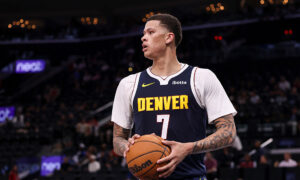
Photo by Tyler Schank/Getty Images
The Denver Nuggets are asking for a Walker Kessler price in a Peyton Watson sign-and-trade. Nobody is paying it. And that might be exactly how the Denver Nuggets designed this to play out.
Jake Fischer of The Stein Line reported Friday that the Nuggets’ sign-and-trade asking price for Watson has been “too steep for the Clippers to deeply consider.” As a result, Fischer reported, there is “an increasing possibility” that the Clippers pivot to re-signing their own restricted free agent, Bennedict Mathurin. The Atlanta Hawks, Fischer added, have shown “fresh interest” in Watson, but that would also require a sign-and-trade to work.
The price Denver is asking? Fischer reported that “sources maintain that the Nuggets are seeking compensation on par with what Utah received from the Lakers in their recent sign-and-trade swap that made Walker Kessler a Laker.”
That return, completed last week, was two unprotected first-round picks in 2031 and 2033 and two first-round swaps in 2028 and 2030 — in exchange; the Lakers got a 7-foot-2 center who signed a four-year, $130 million deal.
For Watson — a 23-year-old wing coming off a breakout season interrupted by a recurring hamstring injury and with 303 career playoff minutes — that is an enormous ask for a team to take on, and the Nuggets almost certainly know it.
Fischer reported earlier this week that The Athletic’s Sam Amick relayed Denver plans to match any offer sheet Watson receives while simultaneously staying open to sign-and-trade scenarios. In other words, it seems the Nuggets want Watson or something significant for him.
So what’s actually happening here?
The three teams that were going to “cause angst in the Rocky Mountains” — the Lakers, Chicago Bulls and Brooklyn Nets, per earlier reporting before free agency opened from Fischer and Marc Stein — have all spent their cap space. That means the most likely remaining path to Watson for any outside team runs through a sign-and-trade with Denver.
If teams wanted Watson badly enough and could simply sign him to an offer sheet, they would have done it by now. They haven’t, because they can’t — the cap-space teams are tapped out or are uninterested. Meanwhile, in a sign-and-trade deal, the Nuggets might not even want players back, since it would hard-cap them at the first apron, making the deal even more complex.
That leaves Watson and his agent, Rich Paul of Klutch Sports, in a familiar position. Klutch restricted free agents have played the waiting game before. And across the NBA, this is becoming more of a theme. Jonathan Kuminga’s situation dragged through much of last summer. Josh Giddey’s lingered similarly. Watson is reportedly seeking around $25 million annually. Whether that number is coming from Watson’s camp, the Nuggets’ side or both, the effect is the same: the market is cooling, and leverage is slowly shifting back to Denver on this front — even if it isn’t across the board this offseason.
A source told me a year ago that former general manager Calvin Booth was prepared to give Watson upward of $80 million last summer, had he not been fired. ESPN salary cap insider Bobby Marks projected four years and $90 million ahead of free agency. Matt Moore of The Denver Dig landed at an average annual value of $21.5 million in his own comp-driven breakdown. All of those numbers now look like a ceiling Watson may struggle to reach if no team forces the Nuggets’ hand.
The financial backdrop makes the posture even more logical. The Nuggets already dumped Jonas Valanciunas this week to save money on their tax bill. Bringing back Watson without trading another starter would push the team above the second apron and toward a $200 million tax bill, let alone the $200 million they would be spending on salary. This is because the Nuggets would be in the luxury tax for the fourth time in five seasons, they are classified as a repeat-tax team with a steeper penalty.
An anonymous Western Conference scout laid out the bind to ESPN earlier this offseason: “They could easily just pay him and pay the tax, but we know how the Kroenkes operate. That means sending out either (Cameron) Johnson or (Christian) Braun, and I don’t know where that lands. The injury stuff is a concern, but so is how they struggled without him.”
Watson hurt his hamstring in training camp, slowing the start to what became a breakout year. The injury caught eyes again Feb. 4 — when he went down and was never the same. He returned for five games, then re-aggravated the issue, missing the playoff push and the postseason entirely. Through 15 games in January, Watson averaged 21.9 points and shot 46.2% from 3. For the season, he averaged 14.9 points on 49.6% shooting and 41.7% from deep, with his 53% on corner triples ranking sixth in the NBA among players with at least 1,000 minutes.
Denver missed all of it in the first-round loss to Minnesota. And that’s happened before — Watson has been hurt at the worst possible time in each of the three seasons he’s gotten real playing time.
Still, Watson is likely the last chance this franchise has at developing a star who can impact Nikola Jokic’s prime. The Nuggets don’t have the assets, draft capital or time to find another option. Watson taking yet another leap is probably more likely than Denver getting almost as lucky as it got drafting Jokic in the second round.
The Nuggets retain the right to match any offer. The Kessler-level asking price in a sign-and-trade ensures no one is taking Watson without paying through the nose. And the longer the market stays frozen, the more the final number comes down. This is probably going to drag out.
Related
 Nikola Jokic on Nuggets fans who booed: “They’re not welcome anymore”
 Rookie Trevon Brazile sparks Nuggets in home-opening win
 Nuggets overcome boos, 23-point hole to stun Pelicans in OT of home opener
 Nikola Jokic makes NBA history, now triple double king
 Nuggets are managing Aaron Gordon’s minutes, even on a night they needed every one
 Jokic quiet, Jamal struggles, Johnson hurt as Nuggets debut fades in worst offensive game since 2019

Comments
0 Comments