
Anonymous NBA scout shares concern about a Peyton Watson contract
A Western Conference scout told ESPN that Peyton Watson's hamstring history and Denver's tax aversion could force the Nuggets to move a big name


(Photo by Michelle Farsi/Getty Images)
(Photo by Michelle Farsi/Getty Images)
The Peyton Watson contract conversation isn’t slowing down — and the latest wrinkle comes from an anonymous Western Conference scout who flagged a real concern about the Denver Nuggets’ restricted free agent in ESPN’s new league-wide free agency intel roundup.
The Nuggets, the scout suggested, are in a familiar bind: pay the player, pay the tax — or move someone to make the math work.
“They could easily just pay him and pay the tax, but we know how the Kroenkes operate,” the West scout told ESPN. “That means sending out either Johnson or Braun, and I don’t know where that lands. The injury stuff is a concern, but so is how they struggled without him.”
That’s the dance Denver is set to do this offseason. The public knows it, and presumably, they know it in private, too. ESPN’s report framed Watson as “one of the more intriguing free agents this summer, even though Denver can match any offer sheet,” noting the 23-year-old “fits one of the most coveted archetypes in the modern NBA — versatile 6-foot-8 wing.”
But ESPN also reiterated the financial reality that has shaped every projection of Watson’s next contract: “Retaining Watson and keeping the current roster intact would push Denver far into the luxury tax.”
That tracks with everything reported to this point. ESPN salary cap insider Bobby Marks already projected Watson’s next contract at four years and $90 million in his top-20 free agent rankings, and Matt Moore of The Denver Dig landed at an average annual value of $21.5 million in his own breakdown.
The new ESPN piece, however, sharpened the focus on two specific concerns — both of which Nuggets fans have been wrestling with since the season ended.
The first: Watson’s hamstring.
“One point of potential concern is Watson’s recurring hamstring injuries, which cost him a large chunk of the second half,” ESPN wrote. “Unfortunately, the injury came right after the best stretch of his career in January and early February.”
Watson injured his hamstring in training camp, slowing the start to what was a breakout year. The injury first caught eyes on Feb. 4 — when he went down and was never the same. He returned for five games then re-aggravated the issue, missing the playoff push and the postseason.
Watson averaged 14.9 points on 49.6% shooting and 41.7% from deep, with his 53% on corner triples ranking sixth in the NBA among players with at least 1,000 minutes. His athleticism, defense and tertiary scoring were greatly missed in Denver’s first-round loss to Minnesota.
And a similar situation has played out before, too. Watson was injured late in the 2024-25 campaign and never found a rhythm again. So far, the forward has played only 303 minutes in the playoffs across his four seasons due to several mistimed injuries — a real risk factor as the Nuggets weigh whether to commit nearly nine figures to a player who has yet to consistently impact a postseason.
The second concern is the league-wide assumption that the Kroenke ownership group won’t simply absorb the tax bill. KSE ducked the tax at the trade deadline with Josh Kroenke citing the team didn’t get worse while getting cheaper but they also didn’t get better while in a title window. If they dip under the tax line again they’ll avoid the repeat-tax penalty moving forward but there is no team-building hindrance in being a repeat taxpayer, just a burden on KSE’s bottom line.
ESPN noted “the belief around the league is that Cameron Johnson (on an expiring $23 million deal) or Christian Braun (on a five-year, $125 million extension signed in the fall) is likely to be moved to create enough room to give Watson something in the per-year range of those players.”
That belief isn’t new in Denver, either. Josh Kroenke said at the season-ending news conference that “if we deem running it back the most competitive thing we can do for the roster, that’s probably what we’re going to be doing” — but the financial picture Marks laid out has the Nuggets already $18 million over the luxury tax and $2.2 million above the second apron. Add to that Braun is likely unmovable on his new extension that is just kicking in after his injury-plagued tough season, and it sets up a situation where keeping Watson may result in the loss of both Johnson and Aaron Gordon and/or Jamal Murray, too.
Knowing KSE, and the excuse they have to shake up the team after such a brutal end to the season. The question more seems to be who gets moved rather than if.
The other side of the scout’s concern — “how they struggled without him” — is the part Nuggets fans saw play out in real time. Denver’s depth was exposed in the first-round loss to Minnesota with Watson sidelined, particularly at the forward spots, and his defensive versatility on the wing has become one of the most difficult skill sets to replace on the open market.
Watson is likely the last chance the team has at developing a star who can impact Nikola Jokic’s prime. They don’t have the assets, draft picks or time to play the percentages at another option — chances are Watson taking yet another leap is more likely than the Nuggets getting almost as lucky as they got by drafting Jokic in the second round.
Watson can start negotiating an offer sheet with another team beginning June 30. As previously reported by NBA insider Jake Fischer and Marc Stein, the Lakers, Bulls and Nets remain the three cap-space teams most likely to test Denver’s front office.
The Nuggets retain the right to match any offer. Whether they want to — and what gets moved if they do — is shaping up to be the defining question of their offseason.
As the scout put it, the injury stuff is a concern. So is what the Nuggets looked like without him.
Related
 Deion Sanders visits the Nuggets in Boulder
 Nuggets turn one-night nemesis into backup point guard option
 The Nuggets say they’re fine, but Aaron Gordon named their problem
 Christian Braun says his ankle is fine after injury-plagued season
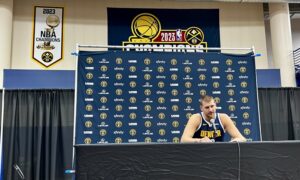 Nikola Jokic makes it clear again: He will sign an extension with the Nuggets
 First NBA MVP and Nikola Jokic admirer passes away

Comments
0 Comments