
Of the many woes for the Denver Broncos, run defense tops the list
For teams to defend the run as badly as the Denver Broncos have over a three-game stretch, the outlook is astoundingly grim.

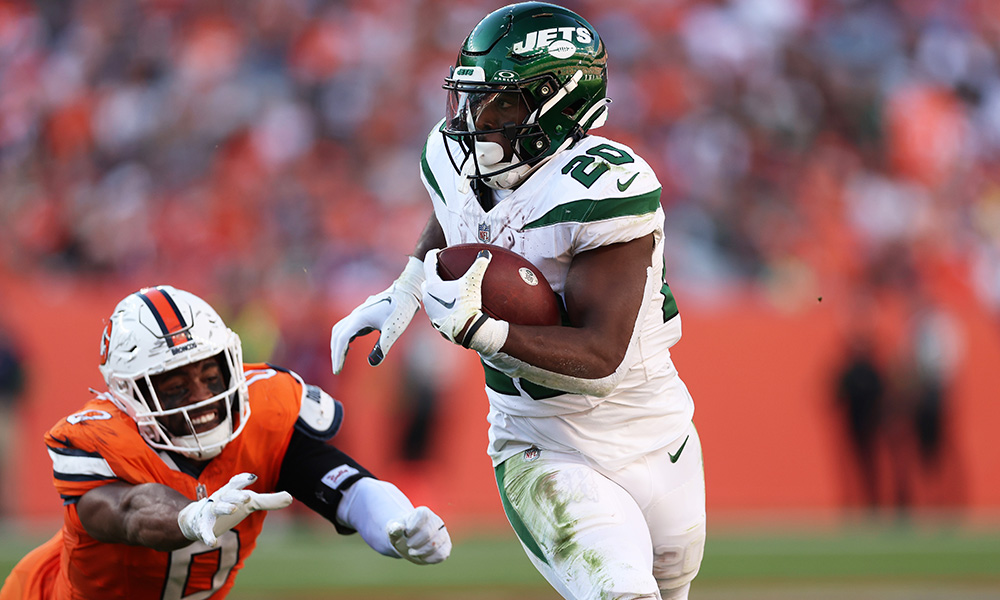
(Photo by Matthew Stockman/Getty Images)
(Photo by Matthew Stockman/Getty Images)
Among the myriad problems that ail the Denver Broncos right now, one stands atop the ever-growing list:
They can’t defend the run.
To describe their run defense as “bad” is inadequate. Since the Broncos went to Miami, their run defense has mostly resembled 11 traffic cones. Seeing as how the team opted to wear orange jerseys and pants, the comparison seems particularly apt.
The New York Jets entered Sunday with a ground game that hadn’t reached its potential. Its per-carry average of 4.7 was healthy; its per-game average of 95.5 yards was not.
That changed Sunday as they trampled the Broncos for 234 yards and a 7.3-yards-per-carry average.
On Breece Hall’s 72-yard touchdown run, only Kareem Jackson manages to lay a hand on the second-year running back. And even that is a mere graze. So thorough was the Jets’ domination off the snap up front that even the fullback leading through the hole is completely untouched. Nick Bawden had look for someone to block before finally turning toward Damarri Mathis.
“We got wide yesterday on the big run,” Broncos coach Sean Payton said.
YEAH, WE'RE THINKING @BREECEH IS BACK.#NYJvsDEN on CBS pic.twitter.com/c8VcYS2XKL
— New York Jets (@nyjets) October 8, 2023
And we’ve seen it before, which spurred me to ask Payton about what was happening and whether there were any common threads of the run defense’s struggles over the last three weeks.
“Yeah, look, good question,” Payton replied to open his conference-call question-and-answer session Monday morning. “Just going through it, our gap integrity has been poor in all three games.”
As a result ..
“[Run defense] was the first topic this morning,” Payton said. “In other words, this has been — it’s going to be tough to win games if we can’t stop the run defensively. And we’ve got to get it cleaned up.
“So, I’d start with fitting the right gaps, and then understanding scheme-wise what we’re getting, and how to restrict those holes. And a lot of it, it’s not communication, it’s technique, but that has to get better.”
Indeed, it has to. Because it can’t get worse. Right?
755
Baseball fans — especially those in Atlanta — know this as Hank Aaron’s career home-run total. But this is also the catastrophic rushing-yardage tally in the past three games. It represents the worst three-game stretch in Broncos history and the third-worst in the last 40 years for any NFL team.
But the thing is, it’s just the start. Consider this: The Denver Broncos rank last in the league in yards allowed per rushing play and per passing play. While there are good individual performances in the mix — the emergence of Nik Bonitto in particular — the collective work is a disaster.
The Broncos defense is:
Dead last in yards allowed/play (7.0)
Dead last in yards allowed/rush (5.9)
Dead last in yards allowed/pass play (7.9)
Dead last in total defense (450.6 yards/G)
Dead last in scoring defense (defense accounts for 34.4 pts allowed/game)Abysmal.
— Andrew Mason (@MaseDenver) October 9, 2023
But that’s not the most alarming aspect of the Broncos’ defensive collapse.
Instead, it is this: Run defense that is lousy to this level for a three-game stretch tends to break down the entire team … as the next number demonstrates.
.156
The average final winning percentage of the four other teams since 1980 that allowed at least 750 rushing yards during a single three-game stretch. Those teams are:
- 2019 Cincinnati Bengals: 2-14
- 2016 San Francisco 49ers: 2-14
- 2009 Kansas City Chiefs: 4-12
- 1981 Baltimore Colts: 2-14
If the Denver Broncos hit that average winning percentage, they would finish 3-14.
Fundamentally, the reason is simple: Run defense that is not merely bad, but generationally abysmal involves losing physical and technical battles in the box and at the line of scrimmage. This is a flaw that can’t be covered up, and also manifests itself against the pass, as well, as additional resources (e.g. safeties in the box, working in 4-4 alignments) must be utilized to try and fortify the run defense, which leaves a team vulnerable in the aerial game.
But the offense is culpable in this 1-4 start. Especially after halftime.
1.43
That is the Broncos’ points-per-possession average in the second half this season — including a 1.0 PPP rate Sunday. And if you remove the “Hail Mary” touchdown against Washington from the equation — and that drive, as well — the Broncos’ season-long PPP rate after halftime plummets to 1.26.
The Broncos have averaged 10 non-kneeldown possessions per game, so the 1.43 PPP rate extrapolates to just 14.3 points per 60 minutes, on average.
Denver’s first-half output remains fairly robust by comparison — 3.05 points per non-kneeldown possession, which would be 30.5 points in a 10-series game. That rate, if extended over a full game, would make for a successful equation — unless, that is, you pair it with a defense allowing a staggering 3.51 points per possession, as Denver’s unit is.
***

Comments
0 Comments